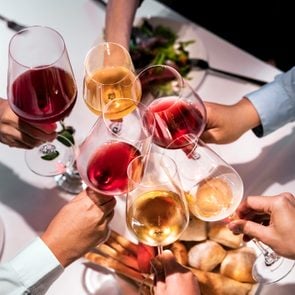
Whether you’re celebrating at a wedding reception, casually hanging out with friends or ringing in the new year, someone will eventually raise a glass and say, “Cheers!” Before you know it, everyone is reaching across the table to clink glasses. I’ve done it on plenty of occasions, of course, but my favorite toasts have been a little less traditional: clinking my champagne flute (filled with “Aunt Jo Juice”) against my nephew’s sippy cup. He was delighted to be included, and honestly, it felt just as celebratory as any other toast.
That’s the funny thing about clinking glasses: It doesn’t really matter what’s in the glass—or even whether it’s a glass at all. There’s something about that little tap and familiar tinkling noise that makes a moment feel special, as though everyone is part of a celebration.
But have you ever wondered, Why do people clink glasses in the first place? How did this little social ritual get started, and is there more to it than just that satisfying sound? As it turns out, the history is worth raising a glass to.
To explore the origins and etiquette of this custom, I consulted Rémy Duthille, PhD, a professor at Université Bordeaux Montaigne in France who researches the history of drinking and toasting, along with etiquette experts Ziying Zhou and Myka Meier. Together, they help separate historical fact from popular myth—and offer advice on how to raise a glass with confidence. Cheers to that!
Get Reader’s Digest’s Read Up newsletter for more fun facts, holidays, grammar, humor, travel and tech all week long.
What are the theories behind why people clink glasses?
If you’ve ever heard that clinking glasses originated to prevent poisoning or scare away evil spirits, you’re not alone. But Duthille urges caution. “I do not know if those popular theories are true,” he says. “I never found any evidence of them.”
Still, they’re fun stories. Let’s take a closer look.
The poisoned-drink theory
One popular explanation claims that people began clinking glasses during the Middle Ages to guard against poisoned drinks. According to the story, diners struck their vessels hard enough for liquid to splash between them, making poisoning a risky proposition.
The problem? The logistics are questionable. There would be no guarantee that liquid would transfer between glasses, let alone in a quantity sufficient to make a difference. There’s also the question of timing. As Duthille points out, “clinking glasses supposes the existence of glasses,” and drinking from individual glasses (as opposed to communal bowls) didn’t become popular in Britain until the late 17th and early 18th centuries. So the familiar image of people touching drinking glasses is not something we can project onto every historical banquet.
The evil-spirits theory
Another explanation suggests that during the Middle Ages, people clinked glasses in the hope that the noise would frighten any evil spirits lurking nearby. Perhaps that’s because the noise resembled church bells, which demons would avoid (obvi). It’s a colorful idea, but again, Duthille notes, there’s no convincing historical evidence that this is how the custom began.
The five-senses theory

Here’s a more romantic explanation. Drinking already engages four of our senses. We see the drink, feel the glass, smell its contents and taste what’s inside. Clinking adds the fifth sense: hearing.
It’s a lovely thought, especially when you’re sharing a special bottle with friends. But Duthille isn’t convinced. “The idea that clinking matters because drinking is an experience of the five senses is beautiful,” he says, “but I do not think it is historically grounded.”
So why do we clink glasses?
The honest answer is that historians can’t point to one definitive origin or say exactly when clinking individual glasses became part of the tradition of raising a drink in someone’s honor. They can, however, trace the history of toasting and the popularity of clinking.
Toasting goes way back
To understand how the familiar “Cheers!” ritual evolved, it helps to start with the custom of toasting itself, which goes back thousands of years to the ancient Greeks, Romans, Egyptians and Persians. The Roman Senate reportedly required citizens to drink to Emperor Augustus’s health at every meal, according to Toastmasters International.
And here’s a fun fact about where the word toast came from: The Romans are believed to have added toasted bread crumbs to wine to reduce its acidity. The word is thought to derive from the Latin tostus, meaning “to dry up” or “scorch.” The Oxford English Dictionary dates toast, meaning “to propose a drink in someone’s honor,” to 1699.
The practice becomes widespread
By the 18th century, toasting had become a familiar feature of social occasions in Britain. People raised their glasses to honor public figures, celebrate important events and express admiration or affection. Toasting became so established that dedicated toastmasters helped organize formal occasions and ensure everyone had a chance to offer a toast. One of the earliest books devoted to the subject, The Royal Toastmaster, was published in London in 1791.
A particularly charming example of a toast becoming a lasting tradition is the Burns Supper, an annual celebration honoring Scottish poet Robert Burns. The first recorded supper took place on July 21, 1801, five years after the poet’s death. Nine of his friends gathered at Burns Cottage in Alloway, Scotland, to remember him, enjoy a meal and recite his work. They also raised a toast to his memory. The gathering inspired Burns Night, now celebrated worldwide around the poet’s birthday on Jan. 25.
The tradition of toasting continued to flourish in the 19th century. In the United States, the period from approximately 1880 to 1920 has even been described as a golden age of toasting. Toast books and pamphlets became popular, newspapers published columns about toasts, and prominent writers contributed their own witty and sentimental offerings. By the late 19th and early 20th centuries, raising a glass together had become a familiar feature of celebrations and social gatherings on both sides of the Atlantic.
Clinking develops alongside toasting
There’s no definitive historical record showing the exact year when clinking became an expected part of every toast. What we can say is that the practice became increasingly associated with the broader toasting ritual as individual glasses and social drinking traditions evolved.
Drinking from individual glasses—and making them part of a shared ritual—gained popularity in Britain during the 17th century. Duthille points to the appearance of specialized English toasting glasses in the 1680s. These vessels were sometimes made for individual clubs and societies, with designs that reflected the group’s identity and loyalties. By the 18th century, toasting was an established part of British social life, taking place in gentlemen’s clubs, political gatherings and private celebrations.
Then it gets solidified in literature
Literature offers another way to trace the custom’s growing familiarity. By the 19th century, writers were including clinking in their stories without needing to explain the gesture to readers. Here are a few notable mentions that strengthened the tradition:
- One early example is Heinrich von Kleist’s comedy The Broken Pitcher. First performed in 1808, the play includes a scene in which one character urges the others, “Clink glasses now!”
- Charles Dickens offers another example in Dombey and Son (1846–48). When young Walter Gills celebrates a new beginning with his uncle, the two clink glasses as they drink to each other’s good fortune. They do it again when Walter proposes a toast to his uncle. The moment is affectionate, turning a simple drink into a shared expression of pride and goodwill.
- Gustave Flaubert’s Madame Bovary (1856) includes a quieter example. Emma offers Charles a glass of liqueur, pours one for herself and the two touch glasses before drinking. Though not a grand celebration or formal toast, it shows the gesture being used in an ordinary, intimate exchange.
- In a scene from Alexandre Dumas’s The Whites and the Blues (1867), several men clink their glasses while drinking to the health of the Republic. The moment takes an unfortunate turn when one man’s glass breaks from the impact, but it offers a vivid example of clinking as part of a public toast.
- Toasting continued to appear in early 20th-century fiction. In James Joyce’s “A Little Cloud,” published in Dubliners (1914), two old friends meet in a bar and clink glasses as they drink to “old times and old acquaintance.”
- William J. Locke’s The Wonderful Year (1916) offers a more celebratory scene: At a French cafe, a group welcomes a young man home from military service by clinking champagne glasses and drinking to his honor.
Today, of course, clinking glasses remains a visual shorthand for celebration, camaraderie and shared milestones. Whether on the page or the screen, that familiar little clink still signals a moment worth raising a glass to.
What are the rules of clinking glasses?

Whatever its origins, clinking glasses has become a familiar part of celebrations. But are there any rules to getting it right? Here are a few common etiquette questions.
Is it rude to clink glasses filled with water?
Not necessarily, though some cultures frown on it. The Germans believe raising a glass with water is bad luck. And in Spain, toasting with water is said to bring seven years of bad luck—particularly in the bedroom.
Meier says these are just superstitions, not universal rules. “From a modern etiquette perspective, it’s perfectly acceptable to toast with water or another nonalcoholic beverage,” she says. Zhou similarly emphasizes respecting those who choose not to drink alcohol, suggesting alternatives such as alcohol-free sparkling wine.
Duthille notes that alcohol’s historical association with toasting may stem partly from beliefs in its healing properties and wine’s religious significance in Christian communion.
Is it bad luck to clink an empty glass?
The ancient Romans reportedly believed raising an empty glass negated the good wishes in a toast, signaling that you were entering a friendship or celebration with empty intentions. Yes, it’s another superstition, but why tempt fate, right?
Zhou recommends having something in your glass. If you’ve finished your drink, Meier suggests simply raising the empty glass without pretending to drink.
Should you make eye contact when clinking glasses?
Yes. “Eye contact is a lovely way to show respect and acknowledge the person you’re celebrating with,” Meier says.
Zhou adds that a superstition in Germany and France warns that avoiding eye contact during a toast brings seven years of bad luck, specifically in the bedroom. Yep, that special brand of bad luck again!
How hard should you clink glasses?
“The golden rule is to clink gently,” Meier says. Delicate glassware, particularly crystal and thin-stemmed wine glasses, can chip or break. Pro tip: Zhou recommends aiming for the widest part of a wine glass’ bowl rather than its fragile rim.
Meier also advises against reaching awkwardly across the table. There’s no need to clink with everyone individually. Simply raising your glass and making eye contact is perfectly acceptable.
When is it appropriate to clink glasses?
Of course, clinking is common at weddings, birthdays, anniversaries and other celebrations, and people do it in plenty of casual settings too. However, in very formal situations, Meier says, “I would only clink glasses if my host or someone actively clinked.”
The key is to always be mindful of local customs and follow your host’s lead. Zhou notes that at formal state banquets and royal events in the U.K. and Europe, guests may simply raise their glasses without touching. In China, toasting can happen throughout a meal, and returning a toast is generally expected. When toasting someone older or more senior in China, she adds, it’s customary to lower your glass so its rim sits below theirs.
Ultimately, a toast is about celebrating a person or moment, not necessarily touching glasses. Whether you clink, raise your drink or simply smile, what matters is sharing the moment. We’ll drink to that!
About the experts
|
Why trust us
At Reader’s Digest, we’re committed to producing high-quality content by writers with expertise and experience in their field in consultation with relevant, qualified experts. We rely on reputable primary sources, including government and professional organizations and academic institutions, as well as our writers’ personal experiences where appropriate. For this piece on why people clink glasses, Jo Ann Liguori tapped her experience as a journalist who often writes about common curiosities, grammar, food and history for Reader’s Digest. We verify all facts and data, back them with credible sourcing and revisit them over time to ensure they remain accurate and up to date. Read more about our team, our contributors and our editorial policies.
Sources:
- Rémy Duthille, PhD, professor of British Studies at Université Bordeaux Montaigne; email interview, Nov. 8, 2026
- Myka Meier, etiquette expert, founder of Beaumont Etiquette, co-founder of The Plaza Hotel Finishing Program and author of Modern Etiquette Made Easy and Business Etiquette Made Easy; email interview, Nov. 6, 2026
- Ziying Zhou, international etiquette expert and the founder of Berkeley Etiquette; email interview, Nov. 9, 2026
- Oxford English Dictionary: “Toast”
- “Toasting Glass” by Rémy Duthille
- Toastmasters International: “The History of Toasting”
- National Trust for Scotland: “Celebrating Burns Night”


The post Why Do We Clink Glasses When Making a Toast? appeared first on Reader's Digest.
from Reader's Digest https://ift.tt/p5lP9Z8
Comments
Post a Comment