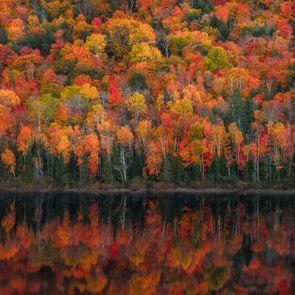
There are many things to love about fall: football weekends, apple cider doughnuts, that first genuinely crisp morning when you can finally break out a sweater, and, of course, the foliage. One day, the landscape is overwhelmingly green. Then, seemingly overnight, the leaves start showing off—yellow, orange, red and even deep purple. It’s a transformation we marvel at every year, but how often do we stop to ask what’s actually happening?
It turns out that behind all that seasonal color is a carefully timed process that helps trees prepare for winter. In other words, there’s more to that fall foliage than meets the eye.
To find out what’s really happening when leaves put on their annual fall show, I spoke with Jason Grabosky, PhD, a professor in the Department of Ecology, Evolution and Natural Resources at Rutgers University, and Jessica A. Savage, PhD, an associate professor in the Department of Biology at the University of Minnesota Duluth.
Read on for the details that will make you appreciate all of those gorgeous colors even more.
Get Reader’s Digest’s Read Up newsletter for more fun facts, humor, cleaning, travel and tech all week long.
What makes a leaf green in the first place?
Time for a quick science refresher: A leaf is green because it contains a pigment called chlorophyll. As Savage explains, that’s what helps plants capture light energy for photosynthesis, the process by which plants make sugars. Chlorophyll absorbs many wavelengths of light but reflects green, which is the color we see.
Throughout the growing season, chlorophyll is constantly made and broken down, keeping leaves green while the tree captures sunlight and produces energy. But as fall approaches, the tree changes its priorities.
Why do leaves change color in the fall?
As summer turns to fall, trees begin preparing for winter. One of their biggest signals is the changing amount of daylight—specifically, the increasing amount of darkness. “When the nighttime gets too long, the tree stops building that molecule because it’s expensive to build and it’s not getting the payout before it rips and breaks again,” Grabosky explains. “It’s too much work.”
As chlorophyll production slows, the green fades. But the tree isn’t simply letting the leaf go to waste. “To avoid losing all of these nutrients when leaves drop, plants reabsorb them in the autumn,” Savage says. The tree begins pulling nutrients out of its leaves and storing them in its branches and trunk, essentially giving itself a little winter savings account.
Why do leaves turn orange, yellow and red, in particular?

Here’s where things get colorful—and interesting. Leaves contain several pigments besides chlorophyll, including carotenoids, which produce yellow and orange hues. These pigments are present during much of the growing season but are masked by green chlorophyll. As the green fades, those yellow and orange tones become increasingly visible. So that gorgeous yellow leaf you’ve spotted in October isn’t necessarily making yellow pigment all of the sudden. In many cases, the yellow was there all along. (Bonus fun fact: One carotenoid, lutein, also causes the yellow color of egg yolks.)
Red is a little different. Red and reddish-purple colors come largely from anthocyanins, pigments that some plants produce in the fall. The right weather can help bring out those reds. “The reds are really dependent on those sunny days where [trees are] getting the energy, along with those really cool nights,” Grabosky says.
But scientists don’t think trees make anthocyanins simply to put on a good show. Savage explains that as the leaf’s chemistry changes, it may become more vulnerable to light-related damage. Anthocyanins may help shield the leaf while the tree finishes its seasonal work.
Why don’t all leaves follow the same color progression?
Leaves don’t necessarily follow a universal green → yellow → orange → red → brown progression. Different species have different pigments and respond differently to changing conditions. “Every species is going to be a little bit different because they’re playing the energy game to compete for light, and each has its own little niche as a species,” Grabosky says.
Some leaves turn yellow and then brown. Others develop orange or red tones. Even leaves on the same tree can vary depending on how much light they receive. Savage calls this a “mosaic of leaf colors.” In sumacs, for example, shaded portions may be less red and more orange.
Weather matters too. “If you’ve got sunny days and cool nights, you’re going to get that more vibrant color,” Grabosky says.
Eventually, the tree forms a specialized layer of cells called an abscission zone, where the leaf meets the branch. Those cells weaken the connection until the leaf can drop. So when a leaf finally flutters to the ground, it isn’t simply falling off. The tree has been carefully preparing to let it go.
Why don’t all trees change color in the fall?
They do—but not necessarily in the way we expect. Evergreens, for example, keep their leaves or needles for multiple years rather than shedding them every fall. Older needles eventually yellow and drop, but the process happens gradually within the canopy, Grabosky explains. Other trees may lose their leaves without producing brilliant fall colors. Drought, pests and other stresses can cause leaves to brown or drop early.
Some oaks and beeches even hold onto their brown leaves through winter. Grabosky says several proposed explanations include the possibility that the bitter dead leaves discourage animals from eating them and help protect next year’s buds. The leaves may also provide some insulation.
In other words, not every tree needs a dramatic fall finale.
Is this a regional thing, or do you get changing leaves everywhere in the country?

You don’t need to live in New England to see leaves change color, but geography makes a big difference in how dramatic the show is. Trees throughout the country receive the seasonal light signal, but farther south, you never really get that vast difference in day length and temperature, Grabosky says. As you move north and higher in elevation, you’re more likely to see a dramatic fall display.
Weather can also change the show within a region. Cool nights can intensify fall colors, particularly reds, while drought can diminish the display and cause leaves to brown or drop early.
The types of trees growing in an area matter just as much. “The plants that occur in one area might be different than those that occur in another,” Savage explains. “Northern Minnesota, for example, has many sugar maples, which can produce brilliant orange and yellow foliage. Florida, meanwhile, has many plants with evergreen leaves, including live oaks and rhododendrons.”
So the spectacular foliage of the Northeast isn’t caused by one magic ingredient. “It’s a combination of the kinds of trees, the amount of darkness and the quality of the cool temperatures,” Grabosky says.
And let’s not forget about the tree’s overall health. “If you have a happy, healthy tree going into the fall, you get a better fall color,” Grabosky says. After a particularly hot or stressful year, the landscape may look different.
Does climate change affect fall foliage?
Climate change may be influencing the timing and intensity of fall foliage. While the seasonal light signal remains the same, says Grabosky, “if we’re having longer, milder falls, we’re going to have conditions for photosynthesis a little bit longer.” That could keep green in the landscape longer and downplay some of the reds and oranges.
Scientists are using aerial photography and satellites to track fall foliage and study how climate change is affecting the timing of plant growth around the world. Even the annual leaf-peeping season can offer clues about a changing climate.
Why do leaves grow back green?
When spring arrives, rising temperatures and longer days signal to the tree that it’s time to resume growth. Interestingly, many trees produce young leaves inside buds during the summer—yes, right before fall. “These leaves remain dormant all winter, and in the spring when the buds open, they expand,” Savage says.
At first, the developing leaves rely on sugars that the tree stored the previous year. Then the new leaf starts producing chlorophyll. “As soon as that happens, Grabosky says, “it becomes its own autonomous unit and starts building itself really quick.” The green leaves spend the spring and summer capturing sunlight and making sugars. The days eventually grow shorter, the tree starts reclaiming nutrients, chlorophyll breaks down and the other colors get their turn.
So the next time you pass a wall of red maples or golden oaks, take a closer look. Fall foliage isn’t just decoration. It’s the visible result of trees responding to light, temperature and their environment while recycling nutrients and preparing for another season. And you don’t need to make a special trip to appreciate the foliage. As Grabosky says, “just get outside and enjoy one leaf at a time.”
Sources:
- Jason Grabosky, PhD, professor in the Department of Ecology, Evolution and Natural Resources at Rutgers University; phone interview, Oct. 5, 2026
- Jessica A. Savage, PhD, associate professor in the Department of Biology at the University of Minnesota Duluth; email interview, Oct. 2, 2026
- UConn Extension: “Fall Foliage Color: How It Happens!”


The post Here’s What Really Happens to Leaves When They Change Color in the Fall appeared first on Reader's Digest.
from Reader's Digest https://ift.tt/70Izufx
Comments
Post a Comment