Dogs get into all sorts of trouble when left alone (my $200 Ray-Bans lasted one day—now I buy sunglasses at the gas station). But even part-time hermits like me have to leave the house occasionally, and despite all of our high-tech devices, which allow us to watch our pets and even feed them from afar, we can’t always keep them from wreaking havoc.
That’s exactly what happened to a family in Chapel Hill, North Carolina, who watched in horror (via their home security camera) as their pet pooch started a fire right on their living room rug. Everyone was OK, but it could have been much worse—and often is. If it can happen to them, it can happen to you, so I consulted Richard Meier, the principal expert at Meier Fire Investigation, to learn how and why dogs can start home fires.
Read on as Meier, who has more than 15 years and 700 fire and explosion investigations under his belt, walks us through this scary but increasingly common situation.
Get Reader’s Digest’s Read Up newsletter for more safety, humor, travel, tech and fun facts all week long.
How can a dog start a fire when left home alone?
So many ways! But here, we’re talking about dogs who chew on devices containing lithium-ion batteries. Yes, those same batteries that cause devastating car and plane fires can affect our homes too. “Anything with a lithium-ion battery can fail,” Meier says. “Fortunately, most of them fail in a benign fashion, but when they fail catastrophically, it can be very serious.”
An oft-cited, yet older, statistic from the National Fire Protection Association (NFPA) is that pets cause about 1,000 home fires a year, although the current number is likely higher. There’s no specific data yet about pets causing lithium fires, but dogs (and cats) can and do accidentally turn on stove burners, as happened in Maine in March of this year, knock over candles and, as the Chapel Hill family discovered, chew on devices containing lithium-ion batteries.
Why do lithium batteries burst into flames like this?
It’s due to something called thermal runaway, which happens when the battery enters a stage of uncontrolled self-heating. This can be caused by trauma or an internal failure during charging or discharging.
“So, in the case of a dog chewing on a toy, what’s going to happen is that they will puncture the battery, or just the force of the bite will cause some internal damage to the battery, which will cause an electrical short between the anode and the cathode,” Meier says. “It generally follows the same course: It gets hotter and hotter, and it can’t dissipate the heat.”
And that leads to what we saw on the scary security video. “More and more failures occur internally, and then it ends up being a fire or an explosion,” Meier says. What makes things worse is that lithium fires are extremely hard to put out. He says that for larger fires (like car batteries), firefighters can end up using “thousands and thousands of gallons of water.”
What else are lithium batteries in that your dog can get his paws (and mouth) on?

“Oh, it’s becoming very ubiquitous,” Meier says. “The mouse on my computer right now has a lithium-ion battery in it,” he added, before rattling off a long list of potential culprits, including cellphones and remote controls. I don’t know about you, but I keep my mouse on the couch right next to me (and my dog’s gnawing teeth), so maybe I should rethink that.
Here are some other common items that contain lithium-ion batteries:
- Radio-controlled toys
- Smart watches
- Fitness trackers
- Earbuds
- Flashlights
- Television remote controls
- Rechargeable vape devices
“Generally speaking, the bigger the battery, the bigger the problem,” Meier says. “Not that the little ones can’t fail, but they’re generally more benign when they do.” But remember, any failure has the potential to ignite materials (like rugs, curtains and bedding) in the vicinity.
What other items can cause a fire if a dog chews on them?
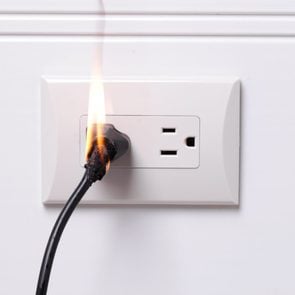
Electrical wires are a big one, and as an electrician, I concur (that’s a stat the NFPA tracks religiously). Between 2020 and 2024, the NFPA reported more than 46,000 annual home structure fires in the United States that were caused by electrical failure or malfunction, including electrical wires and cords.
But while dogs are getting a bad rap here, Meier says we shouldn’t forget about cats. “I had one cat, and I don’t know how he didn’t electrocute himself, because he liked to chew on electrical cords a lot,” he says. So whatever pet you have, it pays to be vigilant. Electrical fires cause 13% of all home structure fires and 18% of all home structure fires deaths each year.
What should you do so this doesn’t happen?
Meier says the smartest thing to do is just pick up your stuff and don’t leave things lying around, whether you’re at home or away. These fires happen fast! “Put [devices] in a place where pets can’t get to them, and keep an eye on your pets when you’re home.” He also says not to charge these devices on the couch or bed, because regardless of Fido’s chewing, it’s a fire danger.
He also says to be very careful about throwing things in the garbage. Anything with a lithium-ion battery needs to be taken to an appropriate recycling facility because they cause hundreds of trash fires every year, particularly at waste facilities. “They don’t get a lot of reporting, but it’s a constant danger for them.”
RELATED:
- American Airlines Just Changed Its Portable Charger Policy, and You’re Going to Want to Read This—It’s a Matter of Safety
- The Horrifying Mistake You’re Probably Making with Your Dog’s Food Bowl—And What to Do Instead
- Meet Penny, the Pup That Won Best in Show at the Westminster Kennel Club Dog Show (You’re Totally Going to Fall in Love!)
About the expert
|
Why trust us
At Reader’s Digest, we’re committed to producing high-quality content by writers with expertise and experience in their field in consultation with relevant, qualified experts. We rely on reputable primary sources, including government and professional organizations and academic institutions as well as our writers’ personal experiences where appropriate. We verify all facts and data, back them with credible sourcing and revisit them over time to ensure they remain accurate and up to date. Read more about our team, our contributors and our editorial policies.
Sources:
- Richard Meier, principal expert at Meier Fire Investigation; phone interview, June 5, 2026
- WRAL News: “Dog sparks Chapel Hill house fire from chewing on lithium-ion battery device”
- WMTW 8: “Dogs likely started Belgrade house fire that caused their deaths, Maine investigators say”
- NFPA: “Electrical Safety in the Home”
- American Red Cross: “Pet Fire Safety”


The post Warning! If You Have a Dog, He Can Actually Start a Fire by Doing This appeared first on Reader's Digest.
from Reader's Digest https://ift.tt/NobiBJ6
Comments
Post a Comment