Recently, I did something gloriously unhinged: I taught a Millennial Dance Party fitness class. We’re talking full video choreography to Britney Spears’s “Oops! … I Did It Again,” which I performed in the red vinyl bodysuit from the music video and a blond wig (because if you’re going to embarrass yourself, you might as well commit). We danced to Usher. We twerked to Beyoncé. We worked out to songs that were playing the last time any of us had a metabolism worth bragging about.
I had expected a decent turnout. But I ended up with a room packed full of middle-aged moms who had put their kids to bed early and come out on a school night—on a school night!—to squeeze into their old low-rise jeans, fold-over yoga pants and Juicy Couture tracksuits (butt bling and all) and absolutely lose their minds to their middle school jams. People were laughing. People were scream-singing the words. People were doing the “Toxic” slither with a level of commitment they probably haven’t brought to anything since 2003. It was one of the most joyful rooms I have ever been in.
Afterward, I kept wondering why a cheery playlist from 20 years ago hit so hard. Why did everyone leave glowing, even the ones who came in stressed, frazzled and running 15 minutes late? I had a hunch it wasn’t just the cardio. So I reached out to Sarah Hennessy, PhD, a cognitive scientist at the University of Arizona who studies music-evoked nostalgia for a living, and she confirmed that what happened in that room had a name: a nostalgic reset.
“When we feel nostalgic, we draw on typically positive memories of the past to enhance our present feelings,” she explains, “reminding ourselves that we exist within a continuous life story and that things can be better in the future because they have been better in the past.”
In other words, Britney Spears may have done more for our collective mental health that Thursday night than anything else we tried all month. Science says so! Read on to discover how it works in your brain and to get pro tips from Hennessy and three other psychologists about how to make it work for you—no red vinyl bodysuit required.
Get Reader’s Digest’s Read Up newsletter for more well-being, humor, travel, tech and fun facts all week long.
What is a “nostalgic reset”?

The term nostalgic reset is taking wellness TikTok and Instagram by storm. The concept is simple: You intentionally listen to music, watch shows or revisit media from your past—particularly from your middle school or high school years—as a way to calm your nervous system when you’re feeling anxious, stressed, overwhelmed or just emotionally waterlogged.
So is nostalgic reset the clinical term? Not quite. “As far as I know, the term nostalgic reset is not a technical one,” Hennessy says. “However, the idea that it conveys—evoking feelings of nostalgia for the past to help regulate emotions in the present—has been studied for many years and certainly has existed for a very long time.”
Michael S. Valdez, MD, a medical director with a background in neurology and addiction medicine, agrees that the idea itself isn’t new even if the label is trending. “People have always used music, places and memories to reset how they feel,” he says. “What’s new is that we’re talking about it more directly.”
The history of nostalgia is wilder than you’d think. Hennessy explains that the term was coined in the 16th century by Johannes Hofer, a Swiss physician who believed it was a serious “cerebral disease.” He described it as a “neurological illness of essentially demonic cause.”
Intense! He came to this conclusion after observing that soldiers serving far from home developed symptoms (think: intense homesickness, malaise, crying, loss of appetite), often triggered by sounds from their homeland. Instead of comforting the poor soldiers, officials at the time advised them to avoid potential triggers—you know, terrible things like mothers’ lullabies—to prevent outbreaks.
So what was once classified as a military health crisis is now, effectively, a wellness trend. Truly, we’ve come so far.
What’s the science behind this?
It may seem silly to call nostalgic music “wellness,” but there’s real research supporting the idea that jamming out to the tunes that got you through middle school and high school can actually improve your mental health. So go ahead, press play on the Killers’ “Mr. Brightside” for a brief blast from the past, then read on for a breakdown of the science.
This is your brain on nostalgic music
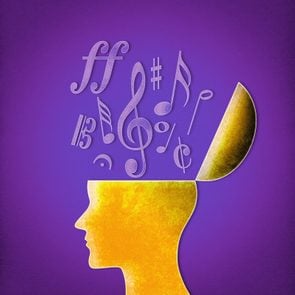
The neurology behind this is genuinely fascinating. To find out what exactly is happening during that 47-minute ‘NSync spiral, Hennessy uses imaging technology in her research to see all the changes in the brain when someone hears a song that transports them back in time.
In a recent study, she and her colleagues asked participants to listen to personally nostalgic music while inside an fMRI machine. The results showed activity in the brain’s reward regions—the same areas that respond to food and sex—as well as in the default mode network, a sprawling web of brain regions associated with self-referential and narrative processing.
If that sounds confusing, think of the default mode network as the part of your brain that narrates your life story back to you. During nostalgic listening, it activates like crazy. Even more striking, participants showed activity in the visual cortex, despite keeping their eyes closed. So when you hear a song tied to a memory, you’re not just remembering; your brain is actually playing the scene back like a movie.
Crucially, none of this happened at the same intensity when participants listened to songs they merely recognized but didn’t feel nostalgic for. So the effect isn’t just about familiarity. It’s about that specific, potent, bittersweet, time-travel feeling of nostalgia.
“Nostalgia pulls on networks tied to memory and emotion at the same time,” explains Dr. Valdez. “When you hear a song or revisit something familiar, the brain links that input to a stored experience, often one that feels safe or meaningful. That can shift your emotional state pretty quickly and help reconnect to a state your brain already knows.”
The health benefits of music are well-established on their own, but nostalgic music appears to amplify those effects by adding that self-referential, reward-system layer on top. Licensed marriage and family therapist John Sovec, who incorporates nostalgic resets into his work with clients managing stress and anxiety, explains that familiar sounds and scenes signal safety to the brain, triggering the release of the feel-good neurochemicals dopamine and oxytocin while simultaneously counteracting cortisol and adrenaline, the stress hormones that love to ruin your Tuesday evening.
Fact: Your old playlist is basically a pharmaceutical-grade chill pill. Without the co-pay.
Teenage songs just hit different
You may have noticed that it’s almost never a song from the past year that sends you into that blissful, floaty, everything-is-fine state. Instead, it’s usually something from when you were 14 or 16 or maybe 19. That’s not a coincidence; it’s a documented psychological phenomenon called the “reminiscence bump.”
The reminiscence bump refers to our well-documented tendency to have unusually vivid and plentiful memories from roughly ages 10 to 30. This is the period when we’re forming our identities, experiencing many emotional “firsts” and making intense social connections, all of which makes memories from that window especially sticky in our brains.
When it comes to music specifically, research suggests the prime years may be even narrower. Studies point to ages 9 through 19 as the era when music becomes most deeply encoded with personal meaning.
This is why Hennessy recommends starting your nostalgic reset right there. “My advice is to find the music you were listening to between ages 9 and 19—or even just popular music from those years—and see what it feels like to listen to it and mentally time-travel.”
The songs from that era aren’t just songs. They’re psychological anchors tied to who you were, who you were becoming and how you felt in some of the most formative moments of your life. No wonder hearing them feels like being wrapped in a very specific, very cozy emotional blanket. (Or in the case of my dance class participants, a very sweaty Juicy tracksuit.)
So can listening to music from your childhood really help you feel better?
Yes, definitely. And the research on it is pretty compelling. Nostalgia has been shown to alleviate loneliness, increase our sense of meaning in life and improve what researchers call “self-continuity”—our innate sense of being a coherent self across time. All of that, unsurprisingly, tends to make us feel better.
Hennessy says that we’re actually more likely to feel nostalgic when we’re already in a negative or lonely state, “likely because our brains and bodies know nostalgia can alleviate this discomfort.” Your brain is, in this sense, self-medicating with Christina Aguilera’s “Dirrty.” Which is either reassuring or slightly alarming, depending on your perspective.
Will all types of nostalgia give you a feel-good boost?

You bet! It’s not just music. The research on nostalgia and emotional well-being is well established with any type of nostalgia, including movies, books and even places. It’s been shown to counteract loneliness, boredom and anxiety, and even to make people feel more connected to others.
The effect makes sense when you consider what nostalgia actually is: a warm, bittersweet reconnection to the self you’ve been across time. It’s a reminder that you’ve survived before, that good things have happened and that more good things are possible. That’s genuinely useful when you’re having anxiety insomnia.
But if part of what you’re dealing with is loneliness or disconnection, nostalgic music may be particularly helpful, precisely because so many of the memories tied to it are social ones—the car rides, the basement parties, the dances, the summers. You’re not just remembering a song; you’re briefly being that version of yourself who felt so loved and connected.
How can you use throwback tunes to feel better?
The good news: This is not complicated. You don’t need a subscription service, a guided meditation or anything more sophisticated than a playlist and 10 minutes. Here’s how to make it work.
Start in your reminiscence bump
Hennessy recommends going straight to music from ages 9 to 19. Even if you don’t have a specific song in mind, searching for a “top hits of [any year between those ages]” playlist will likely surface something that stops you cold. That involuntary, full-body response—the gasp, the “Wow, I’d forgotten about this song!”—is exactly what you’re looking for.
Choose music tied to positive memories
This part matters. Hennessy notes that “the positive benefits of nostalgic experiences tend to be specific to memories for events that were positive at the time or that have some sort of positive arc associated with them.”
Music is powerfully tied to both happy and painful memories, so be intentional—and skip the heartbreak soundtrack.
Be deliberate about it
Valdez emphasizes that the most effective version of a nostalgic reset is an intentional one. “Pick something specific that you associate with a stable or positive period,” he says.
There’s a difference between stumbling into nostalgia while half-scrolling Spotify and actually sitting down, putting on headphones, closing your eyes and letting yourself go somewhere. The latter tends to work better. Think of it less like background music and more like a quick mental field trip.
Try pairing it with grounding techniques
Sovec suggests deepening the effect by combining nostalgic listening with focused breathing, body scanning or journaling about the sensations and memories that come up. The goal, he says, is to make the experience more than just an escape. Let it become an in-the-moment tool for calming your nervous system. Writing down what you felt, even briefly, helps you carry the reset forward after the song ends.
Do it with other people
This one is Hennessy’s emerging hypothesis, and it tracks with everything my dance class taught me. “So much of nostalgia is remembering moments of social connectedness and memories of loved ones,” she says. “I think it’s possible that listening to nostalgic music with loved ones may offer even greater benefits than solo listening, particularly when the music is associated with shared positive memories.”
If you want proof, just find a room full of Millennial moms, play “Crazy in Love” and watch what happens. (Or pop on “Iris” by the Goo Goo Dolls, the go-to soundtrack for the recent ’90s trend on social media.) I know my research isn’t official, but I’d say the data is pretty clear.
Keep it simple
The bottom line when it comes to any nostalgic reset is that you shouldn’t spend all of your time connected to your headphones and reliving your teenage years. “Keep it simple, and don’t overdo it,” Valdez says. “It’s meant to reset you, not keep you stuck in the past. If you come out of it feeling more grounded, it’s doing what it’s supposed to do.”
Now if you’ll excuse me, I have an entire anxiety-reducing playlist to curate. It will be extremely 2003. I have zero regrets.
RELATED:
- It’s Not Your Imagination: Annoying People Are Literally Taking Years Off Your Life
- Go On, Give Up the Grudge. A New Study Says Forgiveness Is Good for Your Health
- Doing This Simple Activity Could Reduce Your Stress Level by 22%—And You’re Never Going to Guess What It Is
About the experts
|
Why trust us
At Reader’s Digest, we’re committed to producing high-quality content by writers with expertise and experience in their field in consultation with relevant, qualified experts. We rely on reputable primary sources, including government and professional organizations and academic institutions as well as our writers’ personal experiences where appropriate. We verify all facts and data, back them with credible sourcing and revisit them over time to ensure they remain accurate and up to date. Read more about our team, our contributors and our editorial policies.
Sources:
- Human Brain Mapping: “Music-Evoked Nostalgia Activates Default Mode and Reward Networks Across the Lifespan”
- Psychology of Music: “The psychological benefits of music-evoked nostalgia”
- Sarah Louise Hennessy, PhD, cognitive scientist at the University of Arizona; personal interview, April 6, 2026
- Michael S. Valdez, MD, medical director at Detox California; personal interview, April 4, 2026
- John Sovec, LMFT, therapist and coach in Pasadena, California; personal interview, April 4, 2026


The post Pump Up the Jams from Your Childhood—It’s the Nostalgic Reset Your Stressed-Out Brain Needs appeared first on Reader's Digest.
from Reader's Digest https://ift.tt/eiGNuTE
Comments
Post a Comment