We’ve all had those absurdly stressful days (and weeks and … well, you get the idea) when go-tos like deep breathing and downward dogging just aren’t doing the trick. I know I can’t be the only one who thinks, If only there were a way to actually clear my brain and feel less overwhelmed.
As it turns out, there’s a research-backed habit that really does alleviate stress: decluttering. Want some more good news? Just a little streamlining makes a big difference. “We think we have to be perfect, but done is better than perfect,” says Los Angeles–based professional organizer Tracy McCubbin, author of Make Space for Happiness: How to Stop Attracting Clutter and Start Magnetizing the Life You Want. And here’s the best news of all: You don’t have to spend all day doing it.
Are you looking for an easy (I promise!) way to reduce your stress? Ahead, I talked to McCubbin and Hollywood feng shui consultant Marie Diamond to find out why getting control of clutter is such a powerful calm-down strategy, what else this habit can do for you and how to streamline your stuff … without stressing yourself out. Read on to learn the secrets of the pros.
Get Reader’s Digest’s Read Up newsletter for more cleaning, humor, travel, tech and fun facts all week long.
Why is clutter so draining?
Living with clutter ramps up your stress levels because it forces your brain to always be “on.”
“If you’re living in a cluttered space, you are basically kicking yourself into decision fatigue,” says McCubbin. “Everything that’s out and about is something you’re looking at like, ‘Do I have a home for it? Am I ever going to use it?'” That gets exhausting fast.
The problem with having three pairs of black shoes by the front door (guilty!) and stacks of unopened mail on the counter (um, guilty again!) is that your brain can process only so much before it becomes overwhelmed and taps out. “That’s the science of why clutter bothers us,” McCubbin says. That tracks for me, and the random junk on the main level of my house gets especially irritating at the end of a long workday.
Clutter affects your home’s energy too

“Feng shui teaches us that energy should be able to move freely around the home,” says feng shui expert Diamond, author of Your Home Is a Vision Board. “When our homes start to fill with objects we no longer really need, this positive flow of energy can begin to slow down.” When that happens, the trapped energy starts to affect our mood. “It’s this sluggish, stagnant energy that can cause us to feel like we’re stuck in the past,” she says, and it prevents us from accomplishing our goals.
Science backs this up. A cluttered home makes people feel stressed out and less in control, according to a 2016 study published in the Journal of Environmental Psychology. In fact, just the perception of an overly cluttered space is a happiness drain. A 2021 study published in the same journal found that people who believe that their homes are cluttered feel less happy and productive than those who don’t—even if both homes have the same amount of clutter.
How does decluttering help?
Clearing out your space keeps your central nervous system from getting stuck in fight-flight-or-freeze mode. That lets your system relax and recover from whatever the day threw at you. As Diamond points out, “It’s much easier to feel safe and calm in a clean and organized environment.”
Decluttering helps you in multiple real-world ways, according to experts:
It reduces stress and anxiety
Paring down your belongings reduces visual clutter and gives your brain a needed break. Think of it this way: If your living room is filled with old mail, Amazon products you plan on returning and an obstacle course of dog toys—oh, plus those workout bands you really should be using—your brain gets stuck on high alert.
“There’s a reason spa treatment rooms are always so minimalist,” McCubbin says. “It’s just less information bombarding you.”
It improves your sleep
This less-is-more approach is especially key in bedrooms, where random stuff can mess with sleep. That stack of bills on your desk or the nightstand filled with books you might read someday becomes one giant to-do list, which is “not great for our mental health and terrible for our sleep,” McCubbin says.
Even if you think you aren’t stressed by the piles, you better believe it seeps into your head. And then you start thinking, I really want to read that book, but I don’t have time to read any books … and yet here I am scrolling on my phone. What’s wrong with me? A better bet: Treat your bedroom like a minimalist chamber made for sleep—and nothing else.
It helps your mood
“When a space is cleared out, it’s just more peaceful,” says McCubbin. And in a world where we’re all overwhelmed with the amount of stuff coming at us—texts, emails, alerts and DMs on multiple platforms, plus everything happening IRL—we could use a mood-booster. The less you have in a room, the less you have to deal with, and that can feel incredibly freeing. Getting rid of old, worthless stuff means you can focus more intently on what you care about … and just that.
It improves your focus
A cluttered cube or office can multiply work stress, according to a study in Environment and Behavior. Researchers found that it’s a particularly big problem when workers are slammed, so taking tiny breaks to tidy up (read on for how to do it!) may make your workload feel more manageable. And in a 2023 report on the well-being benefits of minimalism in Environment, Development and Sustainability, researchers noted that living with less stuff lets us focus on our priorities rather than constantly tend to items that don’t really matter to us.
How can you create a decluttering break in your day?

If it feels like you have way too much on your plate to weed through your stuffed closet, we hear you. Luckily, you don’t need a lot of time to create some breathing room in your home. Here are tiny ways to make it happen:
If you have 30 seconds, use this grandma hack
McCubbin’s grandmother used to say, “Don’t put it down, put it away.” The idea: Instead of dropping your coat on the chair in the living room or your umbrella on the kitchen island, “take the extra two seconds and hang it up in the closet,” she says.
Think of it as a gift you’re giving your future self: Once you get in the habit of putting things away as soon as you come into the house, you won’t have to put them away later because they’re already right where they should be.
If you have 2 minutes, clear out papers you no longer need
This one is great for both work and home. By weeding out old papers, invoices and mail you no longer need, you’ll save valuable time when you’re searching for the documents you do need. Or steal McCubbin’s favorite trick: She makes the most of work calls by using that time to test out pens and chuck the clunkers. Genius!
If you have 3 minutes, fit in a kitchen quickie
No, not that type—the totally fun cleaning kind. If you’re spiraling and feeling stressed, just take a quick little kitchen clean-out break. “Set a timer,” McCubbin urges. “It’s an old productivity hack that works.” When your three minutes is up, you may realize you could go for another three. Yay, you!
If you have 10 minutes, streamline just one shelf
You don’t need a wide-open Saturday to chip away at old crap. “I like breaking decluttering into small chunks,” McCubbin says.
Just tell yourself, Today I’m going to do one shelf in my linen closet. Or how about: Today, I’ll recycle the old catalogs from my entryway table. If you break it up into bite-sized nuggets, you can make serious progress over time … without it eating up your life.
If you have a half-day, have fun trying the art of space clearing
“In feng shui, the act of mindfully removing visual clutter is called space clearing,” Diamond explains. For a first step, she recommends spraying lavender oil (“It helps remove any lingering negative energy.”) Next, sort your belongings to see what you want to keep, what needs to be repaired and what items you just don’t want or need anymore.
“It’s an incredible way to help refresh the energy flow in your home, making things feel lighter, more positive and happier,” Diamond says.
If you have zero time and/or patience for organizing, outsource it
Do you break out in a cold sweat just thinking about sorting through credit card offers, Tupperware tops, random piles of plugs and old work outfits? Call in support, aka a professional organizer or that friend who has everything in her life color-freaking-coded. As McCubbin says, “Not everyone is good at decluttering, and not everyone likes it. And that’s perfectly OK.”
About the experts
|
Why trust us
At Reader’s Digest, we’re committed to producing high-quality content by writers with expertise and experience in their field in consultation with relevant, qualified experts. We rely on reputable primary sources, including government and professional organizations and academic institutions as well as our writers’ personal experiences where appropriate. We verify all facts and data, back them with credible sourcing and revisit them over time to ensure they remain accurate and up to date. Read more about our team, our contributors and our editorial policies.
Sources:
- Tracy McCubbin, professional organizer, founder of dClutterfly and author of Make Space for Happiness and Making Space, Clutter-Free; phone interview, March 9, 2026
- Marie Diamond, celebrity feng shui consultant and author of Your Home Is a Vision Board; email interview, March 9, 2026
- Journal of Environmental Psychology: “Home and the extended-self: Exploring associations between clutter and wellbeing”
- Journal of Environmental Psychology: “The dark side of home: Assessing possession ‘clutter’ on subjective well-being”
- Environment and Behavior: “Does Work Stress Lead to Office Clutter, and How? Mediating Influences of Emotional Exhaustion and Indecision”
- Environment, Development and Sustainability: “Goodbye materialism: exploring antecedents of minimalism and its impact on millennials well-being”

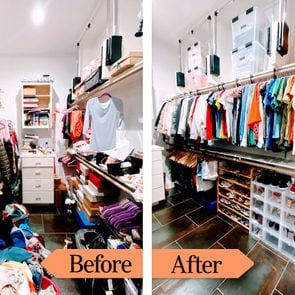

The post Stressed Out? This 3-Minute Task Can Boost Your Mood and Help You Focus appeared first on Reader's Digest.
from Reader's Digest https://ift.tt/yhYv45V
Comments
Post a Comment