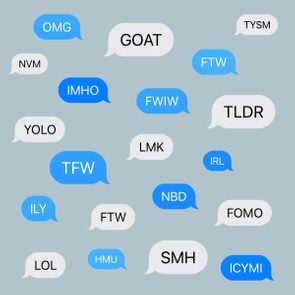
Look, we’ve all had that moment when a kid drops a bit of Gen Alpha slang and we think, Am I having a stroke? One minute you’re chatting with your 13-year-old niece; the next, they’re tossing out lines like, “That pizza was so bussin’.” Suddenly, even though you write and edit for a living, you’re questioning your grip on the English language (true story). As Gen Alpha slang explodes across TikTok, YouTube and Instagram at warp speed, those of us over the age of 15 (or waaaaay over the age of 15) need a little translation guide just to survive small talk.
So I called on a true expert: Arieh Smith, the linguistics-loving YouTuber whose viral video of a speech delivered almost entirely in Gen Alpha slang nailed every term—just check the reactions of the kids in the audience. To prepare, Smith studied Gen Alpha vocabulary (“I watched way too many TikTok videos to count,” he says) and ran his script past actual teens.
With Smith’s help, I pulled together a list of the two dozen most common Gen Alpha slang words you’re likely to encounter right now: the ones that still have rizz and aren’t cringe (at least not yet). Some of these slang terms have crossover generational appeal; others you’ve likely never heard before. Keep reading to decode the dialect of the under-15 set.
Get Reader’s Digest’s Read Up newsletter for more grammar, humor, travel, tech and fun facts all week long.
What sets Gen Alpha slang apart?
Every generation invents its own slang, but Gen Alpha’s vocabulary operates at a different speed and on an entirely different scale. “The difference with Gen Alpha is how it’s been supercharged by social media,” Smith explains. “When one of these videos goes viral, people all over the world can see it.” Instead of slang developing in pockets—schoolyards, friend groups, the cafeteria—it spreads globally and instantly.
Back in Millennial and Gen X days, “it was a little bit more isolated,” Smith says. “Each school might have had its regional slang.” But the linguist says Gen Alpha is flattening these geographic distinctions. “Somebody in New Mexico can be speaking the same slang as somebody in Ireland” because they’re all watching the same content creators.
Gen Alpha are true digital natives, and that changes everything: “The slang can grow faster, and it can die faster,” he says. A single meme can explode internationally in hours, then become embarrassing days later. “Something like 6-7 can blow up instantly, but then within a few weeks, it can become cringe and ironic to say it.”
The generation also thrives on inside jokes. “If something like mewing goes viral and everybody within the Gen Alpha class knows what it is except the teacher, then it becomes funny.” But once adults catch on? Done. In short: Gen Alpha slang is fast, global, meme-driven and shaped by a hyper-online humor. No wonder grown-ups are lost.
What Gen Alpha slang does everyone need to know?
Before we dive into the actual Gen Alpha slang list, a disclaimer: It’s a snapshot in time. As Smith told me, “You really have to ask a 15-year-old” if something is still cool because terms burn out fast.
Still, there are a handful of terms circulating widely right now—the ones you’re likely to hear at school pickup, on TikTok or from your niece who begs you not to say them out loud (seriously, that happened to me yesterday). These are the 24 Gen Alpha slang terms worth knowing … at least until next week.
Aura / negative aura

What it means: The general vibe or energy someone gives off
How to use it: “He has good aura.” / “That comment had negative aura.”
Gen Alpha uses aura like an instant personality read: the immediate vibe someone gives when they walk into a room. Good aura means calming, funny or just pleasant to be around; negative aura means draining, annoying or weirdly hostile. It’s basically mood-reading disguised as mystical wisdom, and kids use it to sound intuitive or emotionally intelligent.
Brain rot

What it means: The feeling of mental deterioration from excessive online consumption, or the intentionally chaotic content responsible for it.
How to use it: “This meme gave me brain rot.”
“Brain rot is such a brilliant term because it encapsulates what everybody thinks about content online, but nobody really says,” Smith explains. “It just perfectly encapsulates the vibe, as they would say, of so much content on the internet these days: It’s all brain rot.”
It’s a versatile term, he says: “And then brain rot, in a very linguistically clever jujitsu move, gets used to describe other things,” even when not referring to online content. BTW: That phenomenon is referred to by linguists as synecdoche.
Bruh

What it means: A reaction to something absurd, disappointing or unbelievable
How to use it: “You forgot your backpack again? Bruh.”
A variant of bro (a casual way to address someone and more of a Millennial term), bruh is pure emotional punctuation. It’s used for disappointment, shock, annoyance or just to fill the silence. Think of it as a verbal eye-roll.
Bussin’

What it means: Extremely good, usually food
How to use it: “That sushi was bussin’.”
If your tween refers to dinner as bussin’, consider that super high praise for your culinary talents. Give yourself bonus points if they drag out the word dramatically.
Cap / no cap

What it means: Cap = lie; No cap = for real
How to use it: “That’s cap.” / “No cap, I’m serious.”
This has become a conversational shortcut for calling things true or false without sounding overly serious. Saying “no cap” pre-emptively signals honesty, like “I swear I’m not making this up.” And if you say “cap,” you’re calling BS.
Cringe

What it means: Embarrassing, awkward or painfully uncool
How to use it: “That TikTok was cringe.”
Gen Alpha wields cringe like a laser pointer for anything that makes them curl up internally: awkward humor, outdated trends, other kids being overly dramatic—and especially adults trying too hard. Smith notes that among this generation, “There’s a strong desire to not be cringe.”
Glazing

What it means: To excessively praise someone to the point of cringe
How to use it: “Stop glazing the teacher.”
Think of glazing as the modern version of brown-nosing (quite popular with Gen X when we were in high school). “Someone is really flattering you, but too much,” Smith says. It’s embarrassing—for them.
GOAT

What it means: Greatest of all time
How to use it: “Simone Biles is the GOAT.”
Kids love assigning GOAT status to literally everything they consider top tier (athletes, YouTubers, snacks).
Smith thinks that this term has the best chance of sticking around. “It fills a place in our lexicon that we don’t quite have a word for. The ‘greatest of all time’ is wordy, and GOAT just really just kind of nails the feeling. It nails the vibe.”
Gyatt / gyat

What it means: An exaggerated reaction to someone attractive, often used jokingly
How to use it: “Gyatt, she walked in, and everyone turned around.”
Pronounced gee-yaht, this originated from live-streamers doing over-the-top reactions, particularly when someone attractive walked by. Think of it as cartoon eyes popping out of your head, but in verbal form.
Hits different

What it means: Feels unusually intense or emotional
How to use it: “A nighttime walk hits different.”
Saying something hits different is how Gen Alpha acknowledges when something feels way more intense or emotional than usual and there’s been a profound vibe shift.
Ick

What it means: A sudden, irreversible turnoff
How to use it: “He chews loudly—instant ick.”
The ick is a sudden, strong turnoff triggered by a tiny detail: a mannerism, a habit, a phrase. It’s brutal because it’s immediate and irreversible. Once you get the ick, the crush or friendship is over.
It’s giving

What it means: It resembles, evokes or embodies something
How to use it: “It’s giving cozy fall vibes.”
Saying it’s giving lets Gen Alpha make aesthetic comparisons on the fly. It’s a fill-in-the-blank formula for describing moods, looks or vibes. It can be a compliment (“It’s giving queen”) or a diss (“It’s giving chaos”).
Low-key

What it means: Quietly, secretly or subtly
How to use it: “I low-key love this show.”
The slang term low-key allows kids to admit something without fully committing to it emotionally. It softens confessions and opinions, making them sound more casual or secretive. It’s the opposite of being dramatic or extra.
Mewing

What it means: A facial-posture technique meant to define the jawline
How to use it: “He’s been mewing for months.”
The concept of mewing is part internet beauty hack, part joke. Gen Alpha uses the word when teasing someone who’s trying to improve their jawline by pressing their tongue against the roof of the mouth or when mocking unrealistic beauty trends. It’s half sincerity, half meme.
Not gonna lie

What it means: An honest preface to a statement
How to use it: “Not gonna lie, that was wild.”
Gen Alpha uses this as a soft preface before delivering honesty, criticism or a surprising admission. It signals, “Brace yourself. I’m saying something real.” And in true Gen Alpha fashion, they tend to abbreviate it NGL.
Smith admits, “I like not gonna lie.” Apparently, so does Kylie Kelce; though she’s a Millennial, Not Gonna Lie is the name of her podcast.
Ohio

What it means: Strange, cursed, chaotic or surreal
How to use it: “That video is so Ohio.”
Invoking the great state of Ohio is shorthand for anything bizarre, cursed or chaotic. The joke is that wild things “happen in Ohio,” so kids use it to label surreal memes, weird behavior or anything that just feels off.
OP

What it means: Overpowered or overpowering
How to use it: “His aim is OP; bro doesn’t miss.”
This gaming term is now used for situations that are not necessarily gaming-related, according to Smith, to describe something or someone extremely strong, powerful or amazing.
Rizz

What it means: Charisma; the ability to flirt effectively
How to use it: “He’s got rizz.”
The defining Gen Alpha word of the decade, Smith believes it’s “maybe getting slightly overplayed at this point.” To have rizz is to have charisma, confidence, smoothness and charm. By the way, a rizzler is an individual with extreme rizz.
Sigma

What it means: Lone-wolf confidence; doing your own thing
How to use it: “He ate lunch alone—that’s sigma behavior.”
This term originated in internet pseudoscience about personality “archetypes”—a sigma male was described as a lone wolf who’s attractive because he’s unbothered.
Gen Alpha has almost completely detached sigma from its original meaning and uses it primarily in an ironic or funny way. So if you hear “What the sigma?” know that it means “What the heck?”
6-7

What it means: Nothing really (no, really)
How to use it: Say it playfully or dramatically, drawing it out (“six-seeeeven”), repeating it (“six-seven, six-seven”) or pairing it with the gesture that looks like you’re weighing two things, one in each hand.
This viral Gen Alpha catchphrase is mainly used for humor or as an inside-joke reaction. It doesn’t have a fixed meaning, though some believe it’s related to NBA player LaMelo Ball, who is 6 foot, 7 inches tall. Kids say it because it’s trending, funny or confusing to adults. Smith notes, “6-7 has already become the butt of jokes for how ridiculous and overused it is.”
Skibidi

What it means: It references the surreal, chaotic “Skibidi Toilet” meme universe
How to use it: “That’s so skibidi.”
A decidedly odd little word, skibidi is pure Gen Alpha absurdism. According to Smith, skibidi and 6-7 are “in that category of jokes, rather than genuine linguistic innovation.” See also variants of it: skibidi rizz (chaotic or weird flirting skills) and skibidi Ohio rizz (maximum chaotic meme energy combining three Gen Alpha staples).
Twin

What it means: Someone you relate to strongly; your people
How to use it: “OK, twin, that fit is insane.”
Calling someone twin means you relate to them deeply—matching energy, personality or opinions. It’s not about looks; it’s about connection and mutual vibe. The word twin is one of connection and validation.
Vibe

What it means: The energy or mood of a situation
How to use it: “This song is a vibe.”
You probably know this one: Vibe is the Alpha go-to word for the mood or atmosphere of anything: a room, the weather, a playlist, a sunset. It’s all-purpose and can be positive (“good vibe”) or negative (“weird vibe”).
According to Smith, “vibe is probably another one that’s going to stick around. It fills a neat place in our lexicon.”
W / L

What it means: Win / Loss
How to use it: “That outfit? W.” / “That move was an L.”
This is Gen Alpha’s ultra-fast way of judging a situation. W = win, good choice or cool move. L = failure, embarrassment or bad decision. It’s simple, sharp and perfect for instant verdicts.
So study up because Gen Alpha slang moves faster than our aging brains can process. And remember: The minute you start using these words confidently … that’s when they officially become cringe.
About the expert
|
Why trust us
At Reader’s Digest, we’re committed to producing high-quality content by writers with expertise and experience in their field in consultation with relevant, qualified experts. We rely on reputable primary sources, including government and professional organizations and academic institutions as well as our writers’ personal experiences where appropriate. For this piece on Gen Alpha slang, Jo Ann Liguori tapped her decades of experience as a copy editor to ensure that all information is accurate and offers the best possible advice to readers. We verify all facts and data, back them with credible sourcing and revisit them over time to ensure they remain accurate and up to date. Read more about our team, our contributors and our editorial policies.
Sources:
- Arieh Smith, polyglot content creator best known as Xiaomanyc; phone interview, Nov. 20, 2025
- Dictionary.com
- Merriam-Webster
- Online Slang Dictionary
- Slangwise: “Ultimate Gen Alpha Slang Words of 2025”


The post 24 Gen Alpha Slang Terms That Will Help You Understand What Kids Are Even Saying appeared first on Reader's Digest.
from Reader's Digest https://ift.tt/jPaBCZ6
Comments
Post a Comment